
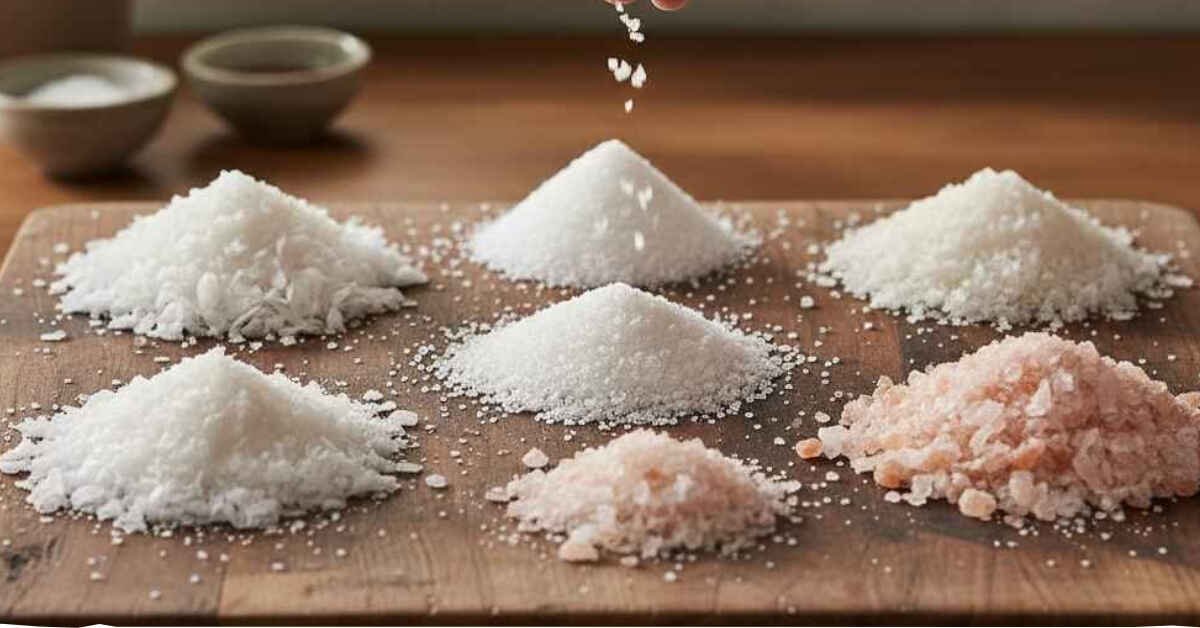
Choosing the right salt types for cooking is a culinary game-changer. Salt is the most essential ingredient in your kitchen. However, different salts have different uses. For example, using a coarse finishing salt when you need a fine-grain salt can ruin a dish’s texture.
This guide helps you stop guessing. Ultimately, it explains the key differences in flavor, texture, and density among the 7 Salt Types for Cooking. Mastering these varieties is the quickest way to upgrade your meals.leading to perfect results like our Crispy Roast Chicken: The Ultimate Salt and Pepper Recipe.
Why Understanding Salt Types for Cooking Matters
Many home cooks use just one all-purpose salt. But, professional chefs understand something else. The size and shape of the salt crystal profoundly affect how a dish tastes and feels. We call this concept the “salt burst.”
- Taste: Different processing methods (mining vs. evaporation) alter the mineral profile slightly. Thus, this affects the taste.
- Density: Volume measurements (like a teaspoon) vary drastically between coarse kosher salt and fine table salt. Therefore, this often leads to inaccurate seasoning.
- Texture (The Finish): Coarse, crunchy salts provide a satisfying textural component. In contrast, fine salts cannot do this.
The 7 Essential Salt Types for Cooking
Understand these seven salt types for cooking. This is the key to perfectly seasoned food.
1. Table Salt (A Common Salt Type for Cooking)
Description: This is the most common household salt. Manufacturers process and refine it heavily. It often includes iodine and anti-caking agents.
Best Use: Use it for baking. Here, you need small, accurate volumes. However, it is too harsh for general seasoning.
Key Fact: It is the densest salt. You need very little when substituting for other salts.
Sourcing Note: We primarily obtain table salt by mining underground salt deposits. Next, producers process it to remove all trace minerals.
2. Kosher Salt (The Essential Salt Type)
Description: This is pure sodium chloride. It offers a very clean flavor. The crystals are large, flaky, and uneven.
Best Use: Use it for general seasoning, brining, and sprinkling over meat. Chefs love this salt. This is because the large crystals make seasoning easy to control.
Key Fact: Salt brands often use different processing methods. Therefore, the density can vary between brands like Morton’s and Diamond Crystal.
Sourcing Note: Manufacturers produce Kosher salt by evaporating saline solutions. However, they use a special method. This results in the distinctive, large, flaky shape.
3. Fine Sea Salt (High-Quality Finishing)
Description: We harvest this salt from evaporated seawater. It keeps trace minerals like magnesium. This gives it a slightly complex, milder flavor.
Best Use: Use it for all-purpose seasoning or sauces. The salt dissolves quickly in these dishes. In addition, its fine nature makes it ideal for rubbing spices into meat.
Key Fact: It is slightly softer in flavor than highly refined table salt.
Sourcing Note: Workers collect this salt from tidal ponds globally. Thus, the flavor profile often varies based on the regional mineral content of the sea.
4. Coarse Sea Salt (The Grinder Salt)
- Description: These are larger, more irregular crystals of evaporated seawater.
- Best Use: Use it primarily in salt grinders. The large crystals are perfect for grinding just before use. Furthermore, it is excellent for creating a salt crust on baked goods.
- Key Fact: It holds its flavor well under high heat.
- Sourcing Note: This salt is usually the first stage of sea salt production. Therefore, producers do not mill the crystals down to a fine grain.
5. Fleur de Sel (The Elite Finishing Salt)
Description: People often call this “salt flower.” Harvesters collect it by hand from the surface of evaporation ponds. Its crystals are delicate and irregular.
Best Use: Crucially, use this only as a finishing salt. Sprinkle it over tomatoes or baked goods right before serving. You use it to add crunch and a burst of flavor.
Key Fact: It has a high moisture content. This gives it a softer bite than most coarse salts.
Sourcing Note: Harvesters often gather Fleur de Sel from the coastal regions of France, like Guérande. Because they gather it manually, it commands a very high price.
6. Himalayan Pink Salt (Mineral-Rich)
Description: Miners remove this salt from the Khewra Salt Mine in Pakistan. Trace minerals, particularly iron oxide, give it its iconic pink hue.
Best Use: Grind it for general seasoning. Also, people often use large blocks as serving plates.
Key Fact: Its primary value in cooking is its aesthetic color.
Sourcing Note: Miners extract this salt from ancient, dry sea beds. Consequently, it contains up to 84 different trace minerals.
7. Flaky Sea Salt (The Texture Giant)
Description: This salt is made into large, thin, pyramid-shaped flakes. This salt has an exceptional crunch.
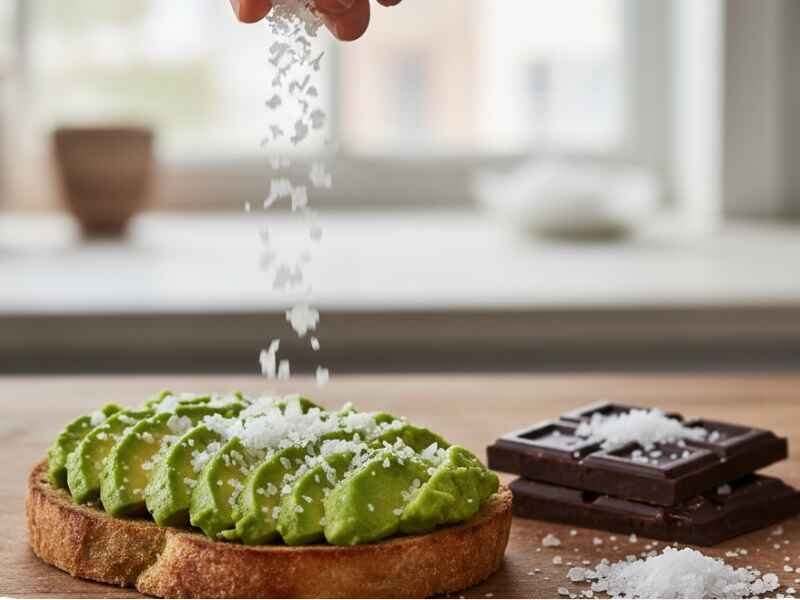
Best Use: Use it for final seasoning on fresh bread or chocolate desserts. Because it dissolves slowly, it delivers a satisfying burst of salty flavor.
Key Fact: It is less dense than kosher salt. Thus, you need twice the volume for the same salinity.
Sourcing Note: Producers boil water to create precise temperatures and conditions. This process forms the unique pyramid-shaped crystals.
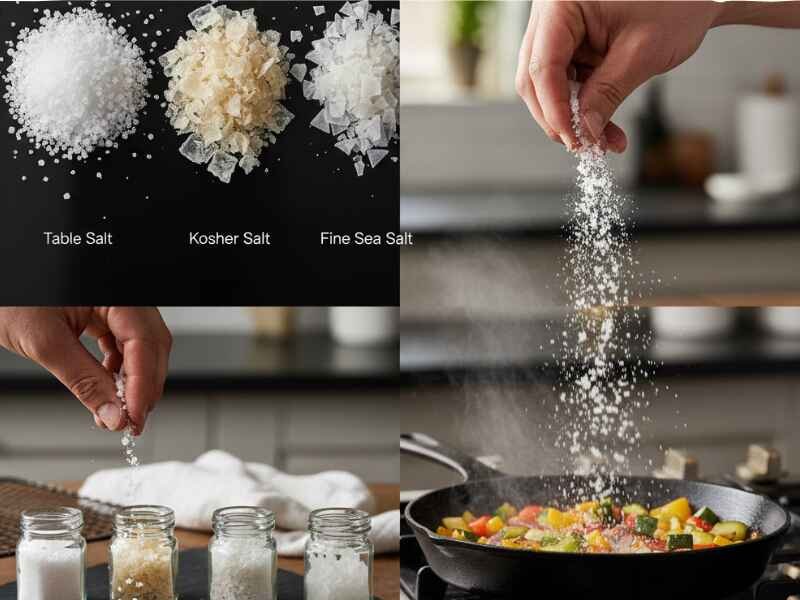
Salt Types for Cooking: Conversion Guide
Therefore, when following a recipe, always try to measure salt by weight (grams) if possible. If you must measure by volume (teaspoons), use this chart to avoid over-salting, since the density varies drastically:
| Salt Type | Equivalent to 1 tsp Table Salt (By Volume) |
| Table Salt | 1 teaspoon |
| Kosher Salt (Diamond Crystal) | 1.5 – 2 teaspoons |
| Kosher Salt (Morton’s) | 1.25 teaspoons |
| Fine Sea Salt | 1.25 teaspoons |
| Flaky Sea Salt | Up to 4 teaspoons |
Pro Tips for Using Salt Types for Cooking
- Season in Layers: Season meat, vegetables, and sauces individually during the cooking process. Then, add a final sprinkle of a crunchy salt just before serving.
- Salt from a Height: When sprinkling salt, hold your hand high above the food. This technique allows the salt to disperse evenly. Thus, you avoid pockets of intense salinity.
- Taste, Taste, Taste: Never rely on volume measurements alone. Instead, taste your food frequently. This is especially true when you adjust the seasoning.
Salt Types for Cooking: Health & Nutrition
While salt is essential for flavor, monitoring sodium intake is important.
- Sodium Control: All salts contain roughly the same amount of sodium by weight. Therefore, the primary way to control sodium is by measuring carefully. This is crucial when you use denser salts like table salt.
- Iodine Importance: Table salt is often iodized. Iodine is an essential nutrient for thyroid health. However, if you primarily use non-iodized salts (like kosher or sea salt), ensure you get iodine from other sources.
Specialty Salt Types for Cooking: Smoked & Flavored
Beyond the basic types, specialty salts offer unique culinary dimensions. These salts are typically used only for finishing.
- Smoked Salts: These salts (often sea or flaky) are cold-smoked over different woods. For example, they use hickory or applewood. This infusion adds a smoky aroma. Use them to finish grilled meat for instant, deep smoky flavor.
- Flavored Salts: These salts infuse with ingredients like truffle, chili, or herbs. They are ideal for adding a burst of complex flavor to eggs or popcorn.
Brining with Salt Types for Cooking: Wet vs. Dry
Different salt types for cooking excel in different preparation methods for meat. Choosing the right method depends entirely on the cut and the salt’s crystal structure. For example, a larger crystal works best for dry brining.
| Method | Salt Type Used | Purpose |
| Wet Brining | Fine Sea Salt or Kosher Salt | The Moisture Boost This method requires you to dissolve salt in water (often with sugar and spices) to create a solution. The solution adds moisture and flavor to very lean meats, such as turkey or chicken breast. Fine Sea Salt or fine-grain Kosher Salt dissolve the quickest, making them ideal for this process. |
| Dry Brining | Kosher Salt | The Flavor Concentrate Here, you rub salt directly onto the meat’s surface and let it rest. The salt first draws out moisture, then dissolves, forming its own concentrated brine that is reabsorbed. Kosher salt’s large flakes make control easy. Furthermore, its structure provides uniform coverage and optimal moisture exchange. |
FAQs About Salt Types for Cooking
Is one salt inherently healthier than another (Pink Himalayan)?
No. Specialty salts contain trace minerals. However, the quantities are negligible for health benefits. Therefore, choose salt based on flavor and texture, not perceived health superiority.
Can I substitute all salts 1:1 by volume?
Absolutely not. The density varies drastically (see the conversion chart). Instead, always use less volume of fine salt (table salt) when you substitute it for coarse salts (kosher salt).
How should I store my salt?
Store all salt types for cooking in an airtight container in a cool, dry place. However, finishing salts (Fleur de Sel, flaky salt) should be stored in a small dish (a salt cellar) near the stove for easy access.
What is the difference between Salinity and Saltiness?
Salinity is the objective concentration of sodium chloride. Saltiness is the subjective perception of flavor. Flaky salts taste saltier initially because the crystals hit the tongue’s receptors all at once before dissolving.
Conclusion
Understanding the difference between the salt types for cooking in your pantry is the easiest way to improve your results. Because salt is a flavor enhancer, using the correct crystal shape is crucial. Ultimately, the flaky crunch of Fleur de Sel and the versatility of Kosher salt will ensure every bite is perfectly seasoned. Go ahead, upgrade your flavor!